
Playing a sport without knowing the rules limits the ability of play. Knowing the most basic rules of Badminton before playing is a big must.
Let’s break down the absolute basics.
The obvious
Badminton is a sport that is played between two player (singles) or four players (doubles). The idea is for a player to score by points against his opponent by hitting a great shot or by forcing his/her opponent to make errors.
The rally ends when the shuttlecock touches the ground. Only one stroke is allowed to pass it over the net. One badminton match is made up of three games, of 21 points each.
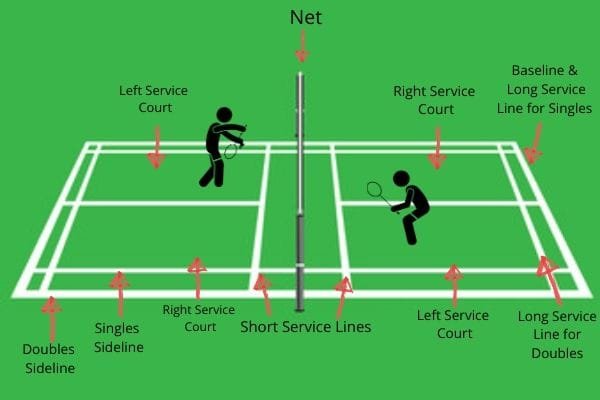
In a badminton match, the court size for a single’s game is 44 feet long X 17 feet wide and for a doubles match it is 44 feet long X 20 feet wide. The height of the net is 5 feet.
A game starts with a coin toss. Whoever wins the toss gets to decide whether they would serve or receive first OR what side of the court they want to be on. The side losing the toss shall then exercise the remaining choice.
At no time during the game should the player touch the net, with his racquet or his body.
The shuttlecock should not be carried on or come to rest on the racquet.
A player should not reach over the net to hit the shuttlecock.
Service
The service starts from the even side of the court.
The server must serve diagonally, and the shuttle must fall in the receiver’s service box. The server must hit the shuttle below their waist, and the racket head must be lower than the hand when serving.
- Diagonal serve: The shuttle must be hit diagonally across the net into the opponent’s service box.
- Underhand motion: The server’s racket head and shaft must be angled downwards, and the serve must be executed with one continuous, uninterrupted forward motion.
- Height restriction: The shuttle must be hit below the server’s waist. In official competition, the contact point must be below (1.15) meters from the floor.
- Foot positioning: Both feet must remain in contact with the floor and not touch any court lines at the moment of impact.
- Contact point: Contact must be made with the cork (base) of the shuttle, not the feathers.
Court & Scoring
Badminton follows a rally point system. A match is played best of three games, with the first player winning two sets of 21 points out of three sets wins the game. If the score ties at 20-20, a player must lead by 2 points to win.
- Singles service court: The server serves from the right court for an even score and the left court for an odd score. The receiver stands in the corresponding diagonal service court.
- Singles movement: Once the serve is hit, players can move anywhere on their side of the court.
- Doubles service court: The same server position rules apply, but the partner’s position and rotation are different. The partner on the receiving team must be inside their service box.
- Service rotation: The server continues to serve as long as their side wins points. If the serving side loses the rally, the serve passes to the opponent.
- In or Out : The shuttle is considered “in” if it lands on or within the boundary lines of the court. If it falls outside the lines, the opponent earns a point.
Singles rule
The side lines in singles is out at all times; even during service.
The back box is considered in during service, in-between the two base lines.
Besides the above service rules and area of play rules, all rules listed above apply.
Doubles rule
Area of play for doubles is the full court.
However, for service, the back box, i.e in between the two baselines is considered out.
You can serve within the sidelines as well.
If the server’s side loses the point, the service will get transferred to the opponents. There is no second serve.
Besides the above service rules and area of play rules, all rules listed above apply.
Faults
Faults are errors in a game that are not allowed. If a player makes a fault, he/she will lose the point. The opponent will gain a point and the service. Besides the service faults listed above, some of the faults are:
At any time during play a person hits the net, he/she will lose the point.
If during play, the shuttle hits touches a player’s body, they will lose the point.
Hitting the shuttle twice is not allowed
Once the shuttle has landed on the ground, it cannot be played. The point will be given to the winning side.
If the shuttle hits the ceiling, it is a fault.
In doubles, if the shuttle nicks/ slightly touches the racket/ body of one player, his/her partner cannot attempt to send the shuttle back. This is considered a fault.
- Shuttle lands out: The shuttle hits the floor outside the boundary lines.
- Shuttle fails to go over the net: The shuttle is hit into the net or doesn’t clear it.
- Shuttle passes through or under the net: It goes through any part of the net’s opening below the top tape.
- Shuttle hits the ceiling or walls: The shuttle touches the ceiling or any side walls.
- Shuttle touches the player or their clothes: It makes contact with any part of a player’s body or their clothing.
- Double hit: The shuttle is hit twice by the same player or racket in a single stroke.
- Contact with the net: A player touches the net with their racket, body, or clothes while the shuttle is in play.
- Invading the opponent’s court: A player hits the shuttle before it has crossed the net, or reaches over the net to hit it, or invades the opponent’s court over or under the net.
- Obstructing the opponent: A player intentionally distracts or obstructs an opponent from hitting the shuttle.
Badminton isn’t just about speed or skill — it’s about understanding the rhythm of rules that bring the game to life. The next time you step onto the court, remember: every serve, every point, and every rally is guided by these unseen principles that make badminton both fair and fascinating. Play smart, play fair, and enjoy the secret side of the game.